
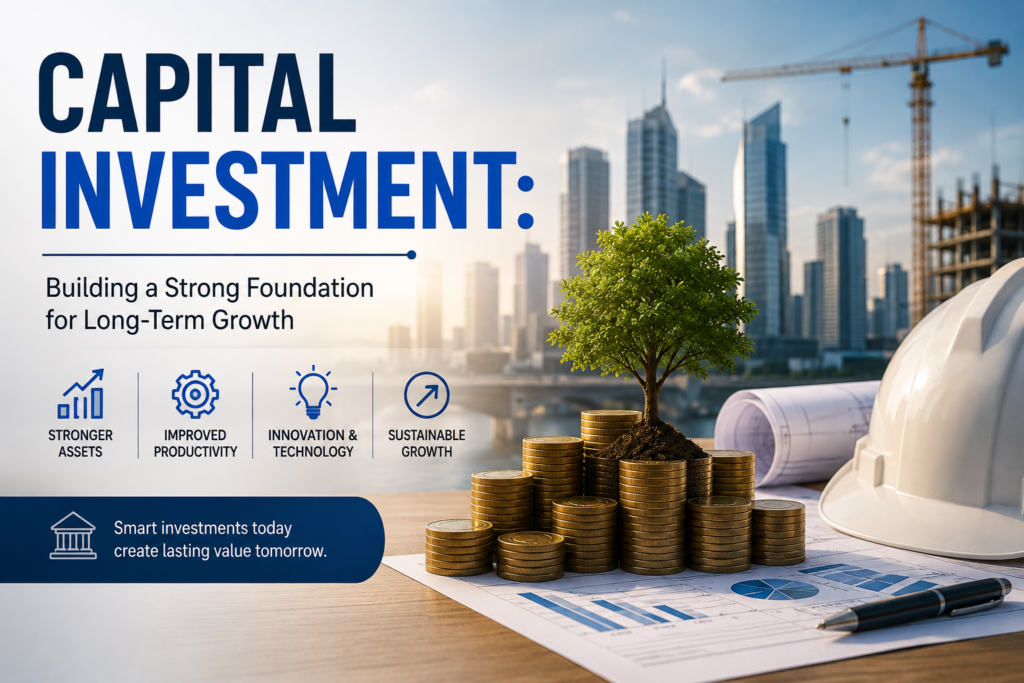
Capital investment is one of the most important decisions a business can make when planning for long-term growth. It refers to the money a company invests in assets, equipment, technology, property, infrastructure, or other resources that are expected to generate value over several years. Unlike operating expenses, capital investments are focused on improving a company’s future capabilities, productivity, and financial performance.
What Is Capital Investment?
Capital investment involves spending money on assets that support a business over the long term. These investments can include purchasing machinery, constructing or renovating buildings, upgrading technology systems, expanding production facilities, purchasing vehicles, or developing major infrastructure.
For example, a construction company may invest in equipment such as cranes, excavators, and specialized machinery. A technology company may invest in servers, software infrastructure, and research and development. These investments require significant upfront spending, but they can help an organization increase efficiency and generate higher returns over time.
[Image Placement: Capital investment concept showing a business building, machinery, technology, financial charts, and growth]
Why Is Capital Investment Important?
Capital investment plays an important role in the growth and competitiveness of a business. Companies need reliable equipment, modern technology, efficient facilities, and other resources to remain competitive in changing markets.
A well-planned investment can increase productivity, reduce operating costs, improve product or service quality, and create new revenue opportunities. It can also help businesses expand into new markets and respond more effectively to customer demand.
However, capital investment requires careful planning. A large investment can significantly affect a company’s cash flow and financial position, particularly when the expected return takes several years to materialize.
Types of Capital Investment
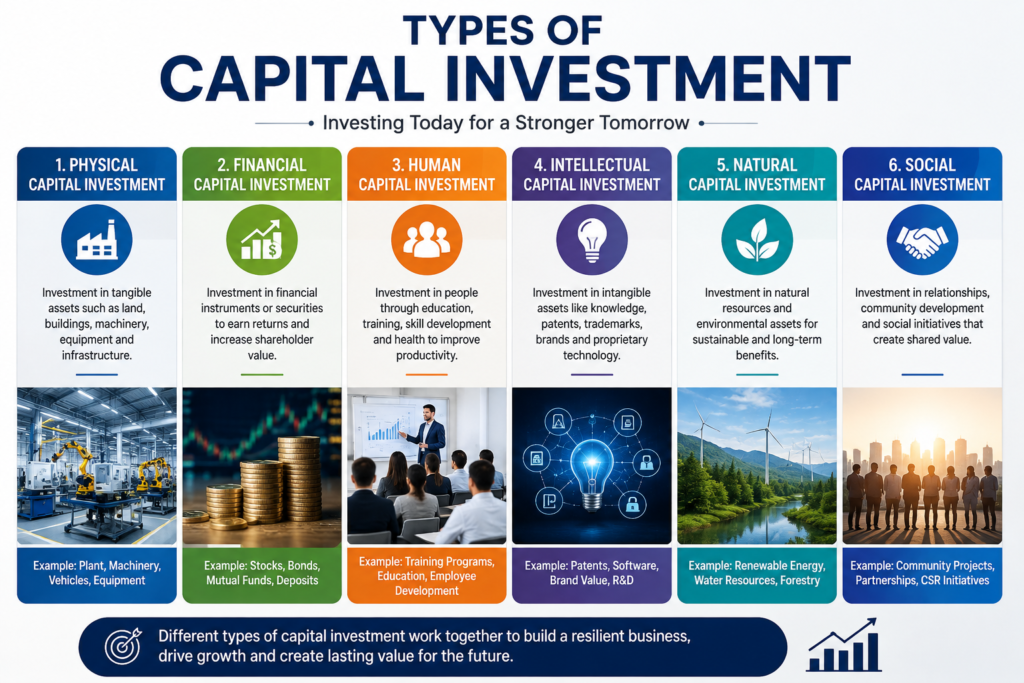
Businesses can make different types of capital investments depending on their industry, financial position, and strategic objectives.
1. Property and Buildings
Investing in buildings, offices, warehouses, manufacturing facilities, and other properties can provide a company with the infrastructure it needs to operate and expand.
For growing businesses, property investments can also provide additional capacity and create opportunities to improve operational efficiency.
2. Equipment and Machinery
Businesses often invest in machinery and equipment to increase production capacity and improve efficiency. This is particularly important in industries such as construction, manufacturing, logistics, agriculture, and transportation.
Modern equipment can reduce manual work, improve safety, increase productivity, and help businesses complete projects more efficiently.
3. Technology and Software
Technology has become an essential part of modern business operations. Investments in software, cloud infrastructure, cybersecurity, automation, artificial intelligence, and information systems can help companies improve productivity and decision-making.
[Image Placement: Modern technology infrastructure featuring computers, cloud systems, cybersecurity, automation, and business analytics]
Technology investments can also improve communication, data management, customer service, and operational visibility across an organization.
4. Research and Development
Research and development (R&D) can also represent an important form of capital investment. Companies invest in developing new products, services, technologies, and processes to maintain their competitive advantage.
R&D investments can help businesses adapt to changing customer needs and develop innovative solutions that create value over the long term.
5. Business Expansion
Capital can be invested in opening new locations, increasing production capacity, entering new markets, or acquiring strategic assets.
Expansion investments are generally designed to generate additional revenue, increase market share, and strengthen a company’s long-term market position.
How Companies Evaluate Capital Investments
Before making an investment, businesses typically evaluate the expected costs, benefits, risks, and financial returns. Management may consider factors such as the initial investment amount, expected revenue, operating costs, useful life of the asset, financing costs, and expected return on investment.
Common financial evaluation methods include Return on Investment (ROI), Payback Period, Net Present Value (NPV), and Internal Rate of Return (IRR). These methods help decision-makers determine whether an investment is financially attractive and aligned with the company’s objectives.
Businesses should also consider non-financial factors. For example, a new technology system may not immediately generate additional revenue, but it could improve security, customer experience, employee productivity, data management, and operational control.
Capital Investment and Business Growth
Strategic capital investment can provide businesses with the resources required to grow. When companies invest in modern facilities, advanced equipment, technology, and infrastructure, they can often increase their capacity while improving operational efficiency.
For example, a construction company investing in project management technology may improve communication between project managers, contractors, suppliers, and clients. Better systems can reduce delays, improve cost tracking, streamline procurement, and provide management with greater visibility into project performance.
[Image Placement: Construction project showing workers, modern equipment, and digital project management technology]
Capital investment can therefore support not only physical growth but also improvements in the way a business operates and manages its resources.
Risks of Capital Investment
Although capital investment can create significant opportunities, it also carries financial and operational risks. An investment may fail to deliver the expected return because of changing market conditions, unexpected costs, lower demand, technological changes, or poor planning.
Businesses should therefore conduct financial analysis and risk assessments before committing significant capital. Companies should also consider whether they have sufficient cash reserves or financing capacity to support the investment without putting unnecessary pressure on their day-to-day operations.
A strong investment strategy should balance potential returns with the level of risk the organization is prepared to accept.
The Role of Technology in Modern Capital Investment
Technology is changing the way businesses plan, manage, and monitor capital investments. Modern financial and project management systems allow organizations to track budgets, monitor spending, manage assets, analyze performance, and forecast future requirements.
Data analytics and automation can also help decision-makers identify investment opportunities and potential risks more quickly. By combining financial information with operational data, businesses can make more informed investment decisions and improve resource allocation.
Digital tools can also provide real-time visibility into project costs, asset performance, procurement activities, and investment progress.
Conclusion
Capital investment is more than simply spending money on new assets. It is a strategic decision that can shape the future of an organization. When investments are carefully planned, properly evaluated, and aligned with business objectives, they can improve productivity, support expansion, strengthen competitiveness, and create long-term value.
Businesses should therefore approach capital investment with a clear understanding of their financial position, expected returns, potential risks, and long-term goals. The right investment, made at the right time, can provide a strong foundation for sustainable growth and continued success.
[Image Placement: Business team reviewing an investment strategy with financial charts, growth projections, and long-term business plans]